Sound meditation
Come Home
Everyone kept telling me to try meditation. "Just sit with it," they'd say. "Focus on your breath."
My internal bullshit detector went off every time, but I knew growth often means stepping outside comfort—so I signed up for a group mindfulness session.
It was pure torture.
"I'm so-and-so, and today I'll guide you through a mindfulness meditation all about feeling good. We're just going to sit still, clear our minds, and focus on our breath…"
Ladies and gentlemen, there I was, legs crossed, sweating with the effort of pushing away every thought screaming in my head, desperately trying to be grateful for each "positive" cue the instructor offered. By the time the hour ended, I was more exhausted than when I began.
It turned out that meditation wasn't about forcing stillness or chasing good vibes. It was supposed to be an invitation to be exactly as we are—thoughts, feelings, and bodily sensations included—without judgment.
What I needed—what I didn't even know I needed—was permission.
Not "Sit still." But "If you feel comfortable, you're welcome to adjust your posture."
Not "Clear your mind." But "Notice your breath, if that feels okay."
Not "Feel good about that!" But "Whatever's here is welcome."
The difference between a command and an invitation is the difference between dysregulation and safety.
In my early days of attempting these practices, I was too emotionally raw and under-resourced to handle hardline directives. A well-meaning instruction to "just breathe deeply" only spiraled me further into anxiety, leaving me wound tighter than before.
Wandering away from that failed meditation, I dove down an internet rabbit hole, searching for alternatives. That's when I stumbled upon sound bathing.
Suddenly, there was a practice that didn't demand perfect stillness or an empty mind—just an open heart and curious ears.
What Sound Bathing Actually Is
Think of your body as more than a vessel for to-dos and obligations.
When did we become so adept at living in our heads—tallying checklists, replaying old wounds, numbing out? Our bodies are constantly broadcasting: "Feed me," "Rest me," "I'm anxious," "I'm tense." Yet we've learned to mute those signals in favor of performance and productivity.
Traditional meditation asks us to reverse that pattern, but for many—especially people carrying trauma—it can feel like being handed a command to do the impossible.
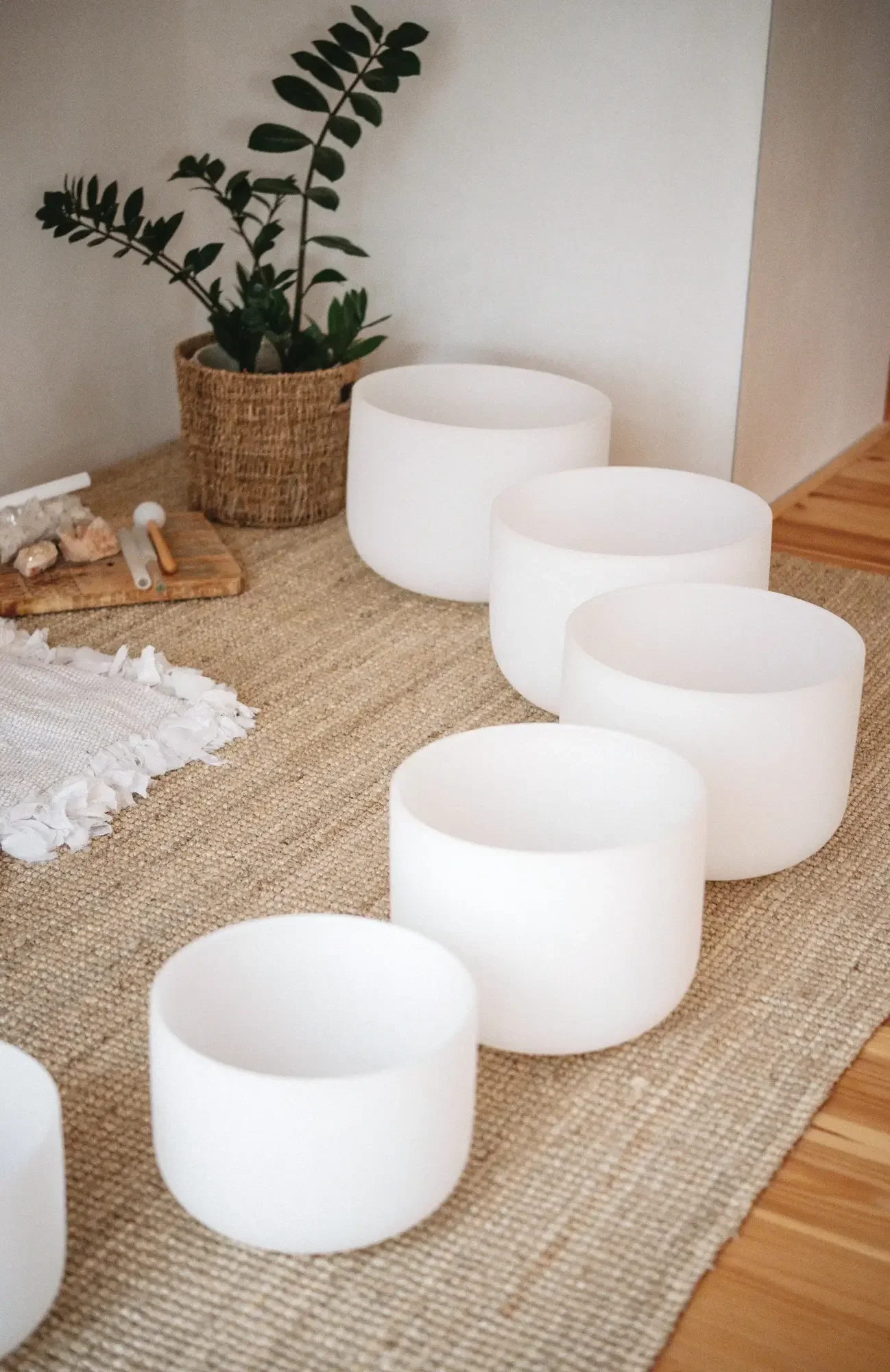
Enter sound bathing: a chance to lie down, surrender, and let waves of sound float through you. Instruments like singing bowls, gongs, and chimes create vibrations that move through your flesh, bones, and tissues.
The physics behind it is deliciously simple yet profound: think about how water dances when you tap the surface—ripples expanding in symmetrical, concentric circles. Singing bowls do the same with the fluids inside us, gently reordering our internal landscape. Researchers can even slow-motion film how those vibrations restructure water molecules. Our bodies are 60% water. Imagine what those ripples are doing inside you.
The Science
Science has our backs, too. Our brains hum along at different frequencies—delta for deep sleep, theta for creativity and meditation, alpha for relaxed wakefulness, beta for active thinking, and gamma for high-level processing.
Slow, sustained tones (around 60 beats per minute) help our brains slip into alpha and theta states, so we can drop into relaxation without force.
Psychoacoustics—essentially, how sound interacts with our nervous system—shows that certain frequencies actually synchronize the left and right hemispheres of the brain. You wind up feeling calm, clear, and grounded without having to wrestle your thoughts into submission.
You Don't Need a Studio
I often remind clients that you don't need a fancy studio or professional sound healer to access these benefits. Start small: find a recording of singing bowls or a playlist of nature sounds, lie down somewhere quiet, and just listen.
If you practice yoga, drench your savasana in sound—let every exhale carry you deeper into stillness. Or steal a five-minute break midday to press play on a simple track of chimes; it can reset your nervous system more effectively than another Instagram scroll.
I don't promise anyone that sound baths will "fix" them. But I can tell you what people report: stress that finally releases. Sleep that deepens. Muscles that unclench. Emotions that move instead of staying stuck.
For me—someone who's spent years carrying tension in my sacrum and anxiety in my chest—those waves of sound feel like a welcome relief. A reminder that my body is more than a problem to solve.
In a world hell-bent on pulling us out of our bodies—first, to solve a problem, then to chase the next deadline—sound bathing offers a gentle way back home: to our breath, to our heartbeat, to our embodied knowing.
It doesn't ask for perfection. It simply invites you to listen.
So when you feel disconnected, overwhelmed, or just plain numb, try lying down and letting the vibrations wash over you. Your body and mind will thank you for the invitation to come back.